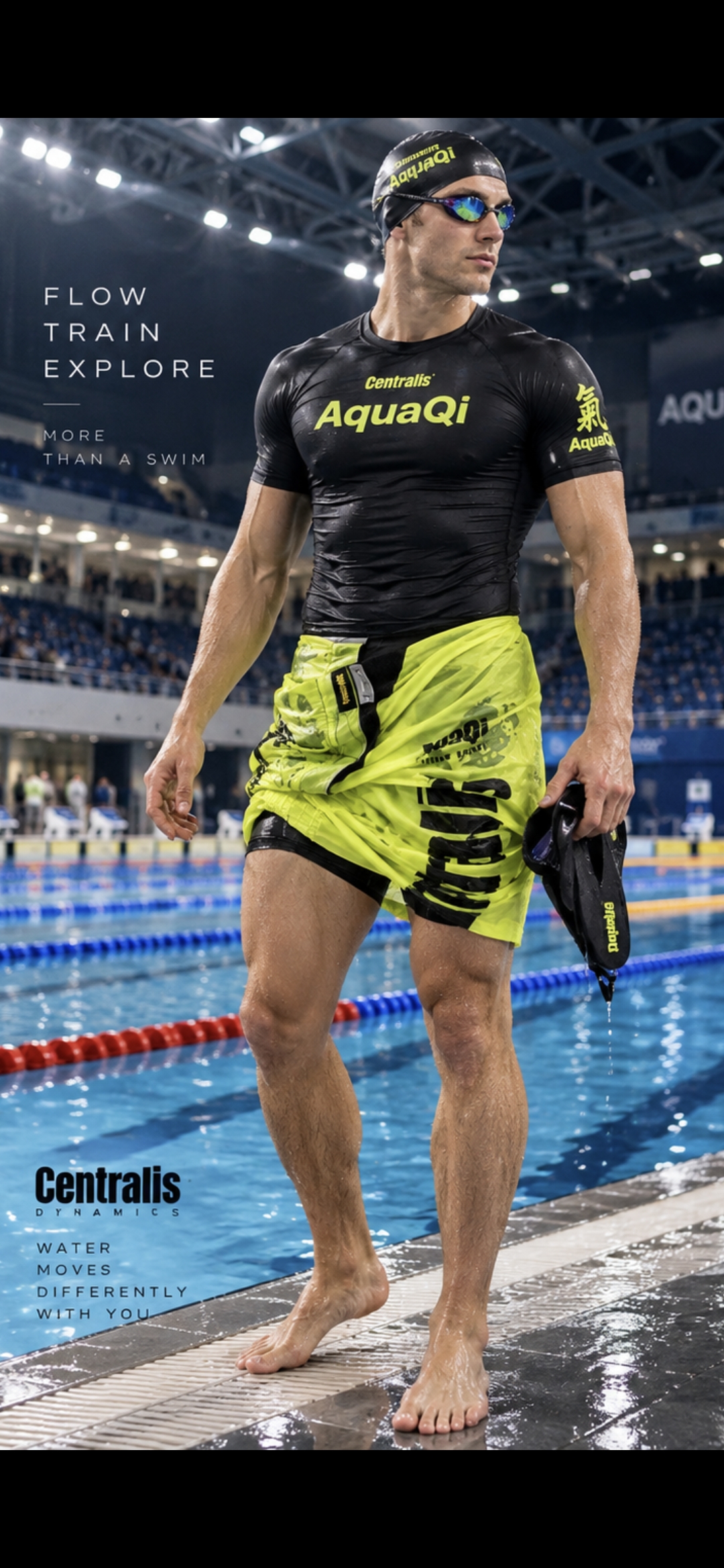
From Rigid Blades to Responsive Fabric: Why AquaQi Feels Different in the Water
Most swimming fins begin with a familiar idea: attach a larger surface to the feet and use the legs to move more water.
AquaQi starts somewhere else. It moves the working surface closer to the body, replaces the rigid blade with responsive fabric, and lets the swimmer feel that surface change while moving through the water.
The Familiar Fin Starts at the Feet
Traditional fins and monofins extend the propulsion surface beyond the swimmer’s feet. The body creates the movement, but the obvious working blade is located at the end of the legs.
That design has become so familiar that the words swimming fin almost automatically suggest a rigid or semi-rigid blade.
AquaQi changes that geometry.
Its fabric begins around the hips and upper legs, continues between and around both legs, and extends beyond the toes. Instead of attaching one working surface only to the feet, AquaQi allows movement from a much larger section of the body to interact progressively with the water.
The idea is not simply to make a softer version of a conventional fin. It is to create a different relationship between the swimmer, the propulsion surface and the surrounding water.
AquaQi does not wait for the movement to reach the feet. The working surface begins much closer to the body’s center.
From Blade to Underwater Sail
A rigid fin keeps a relatively defined shape. AquaQi does the opposite: its shape changes because the swimmer changes it.
Spread the legs and more fabric can open between them. The material becomes more tensioned and creates a larger surface against the water.
Bring the legs closer together and the fabric becomes softer and less tensioned.
This is why the idea of an underwater sail is useful. The swimmer is not simply pushing a fixed blade. Leg spacing, body position, water pressure and movement continuously change the shape and loading of the surface.
That variable response becomes part of the HydroFlow experience.
The Body Becomes More Involved
Because the fabric begins higher on the body, AquaQi naturally invites the swimmer to explore movement beyond an isolated kick.
A wave can begin through the head, chest and upper body, continue through the spine and core, travel into the hips and legs, and finally continue through the fabric.
Body → Hips → Legs → Fabric → Water
Dolphin kick and monofin swimmers will recognize the importance of this connected movement. AquaQi gives that idea a different working surface — one that begins much higher than a conventional blade.
For swimmers interested in training this relationship more deliberately, see
AquaQi for Swim Performance.
A Fin You Can Feel
There is another important difference between rigid equipment and responsive fabric: AquaQi does not only act on the water. The water acts on AquaQi — and the swimmer can feel that interaction.
Different movements create different pressure, tension, folding and release through the skirt.
A swimmer may notice when the fabric loads smoothly, when tension disappears, when the legs open too far, or when a movement becomes more continuous.
This does not mean AquaQi automatically corrects technique. Instead, it gives the swimmer another physical reference for exploring timing, alignment, rhythm, leg spacing and body-wave control.
The fabric does not tell you what to do. It helps you feel what the water is doing.
That feedback relationship is one reason AquaQi can work as both an aquatic experience and a training tool.
Soft Does Not Mean Passive
AquaQi can be folded in the hand, packed into a bag and worn without a rigid blade extending from the feet.
In the water, however, that same fabric can become tensioned into a much larger working surface.
This contrast is part of what makes the system unusual: physically soft equipment can still create noticeable resistance when the swimmer opens and loads the fabric against the water.
The concept is explored more deeply in
From Fins to Fabric: Rethinking the Monofin.
The Difference Continues Outside the Water
Rigid fins influence more than swimming. They also influence the equipment bag.
Long freediving fins and monofins need space, protection and planning during transport. AquaQi is fabric-based, allowing it to fold down into a much smaller volume.
That makes it easy to bring as the main system for a session, an additional training option, or simply a backup when traveling.
The same quality becomes useful for instructors. Several AquaQi systems can travel together without creating the equipment burden normally associated with multiple sets of long fins.
Portability may not change the physics of swimming, but it can change how often a piece of equipment actually makes it to the water.
One System Can Lead in Several Directions
AquaQi does not belong to only one aquatic discipline.
A performance swimmer may use it to explore body wave, kick control, timing and alignment.
A freediver may be interested in soft fabric propulsion, compact travel equipment and movement that begins higher on the body.
An aquatic movement practitioner may slow everything down — floating, spiraling, moving vertically or simply feeling subtle currents through the fabric.
A coach may use AquaQi for one drill inside a normal training session, while another instructor may build an entire HydroFlow class around it.
The product stays the same. The intention changes.
AquaQi can be a fin, a training prop, a feedback surface, a movement tool or the center of a HydroFlow session. What changes is how the person inside it chooses to move.
Different Does Not Mean Replacing Everything Else
AquaQi does not need to replace conventional fins, monofins or ordinary swimming.
A swimmer can use paddles one day, fins the next and AquaQi in another part of training. A freediver can travel with long fins and keep AquaQi in the same bag as another option.
The value is in adding another movement environment — one where the working surface is soft, begins closer to the body and continuously changes with the swimmer.
If you want to explore how body position connects to that experience, read
Why Body Alignment Matters Underwater.
The AquaQi Difference
Not another blade. Another way to meet the water.
Move the body. Let the fabric respond.
Feel the pressure change.
Then discover what happens when the equipment begins to disappear into the movement.
That is HydroFlow.
Experience It for Yourself
The easiest way to understand responsive fabric is not to describe it forever. It is to put it in the water and feel what changes.