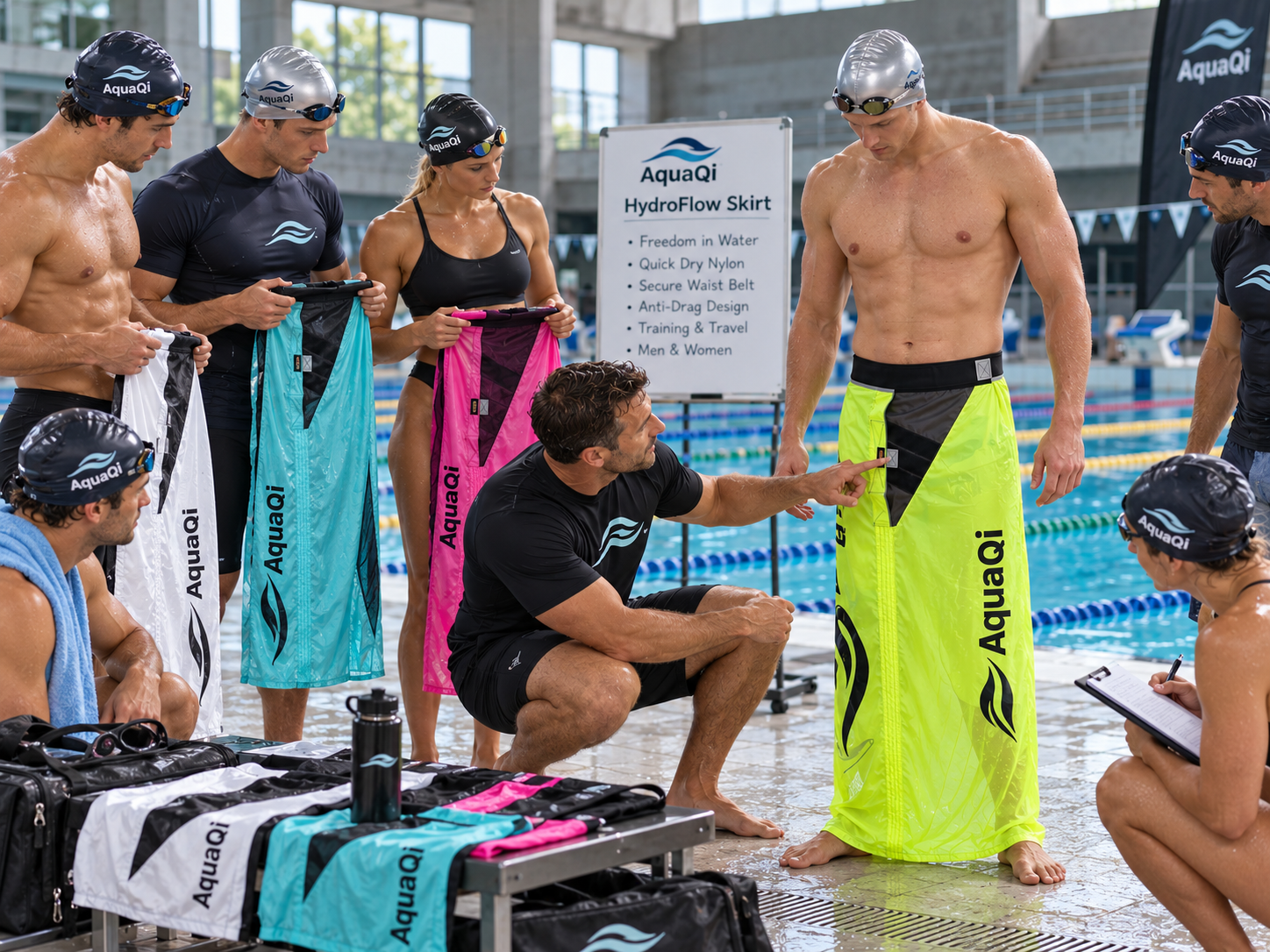
Your First AquaQi Session: A Beginner’s Guide to Finding Flow
The first time you wear AquaQi, the goal is not to swim harder, faster, or farther.
The goal is to notice. Notice how the fabric moves around your legs, how your hips affect the skirt, how the water changes the resistance, and how small changes in rhythm can completely change the way the movement feels.
Start by Understanding the Feeling
AquaQi is different from ordinary swimwear and different from a conventional rigid monofin.
Both legs move inside one continuous fabric structure. The material surrounds the lower body and extends beyond the feet, creating a flexible surface that responds to movement and water pressure.
That means the first few minutes should be about getting familiar with the sensation rather than immediately trying to generate maximum propulsion.
Do less than you think you need. Smaller movements often make it easier to feel how the fabric, body and water are working together.
The easiest way to begin is in controlled water where you can stop, stand, reset and repeat.
AquaQi is a movement-training tool, so the first session should feel exploratory rather than competitive.
Check the Fit Before You Move
Before entering deeper water, make sure the waist belt feels secure and comfortable.
The fabric should fall naturally around the legs and continue beyond the feet when fully extended.
You do not need to pull the material tight against the body. Once in the water, pressure and movement will change the way the fabric sits around the legs.
Take a few moments to walk carefully, adjust the skirt as needed, and become familiar with how much fabric surrounds you.
If you need greater freedom around the feet before entering the pool, the skirt can be gathered upward temporarily and then lowered for swimming.
Begin With a Glide
Before thinking about the kick, experience the water with as little movement as possible.
Push gently from the wall or allow yourself to float forward in a long body position.
Feel where the fabric touches the legs.
Notice whether it opens, folds or presses closer to the body as you move.
Before learning how to move the fabric,
learn how the fabric moves with you.
This quiet starting point gives you something to compare against once you begin adding movement.
Let the Movement Begin Higher
A common beginner instinct is to focus immediately on the feet.
With AquaQi, it is useful to experiment with beginning the movement higher in the body.
Try allowing the chest and torso to begin a small wave. Let that movement travel through the core and hips before continuing toward the knees and feet.
The movement does not need to be dramatic.
In fact, a smaller wave often makes timing easier to notice.
Instead of asking the legs to create everything, experiment with sending movement from the torso through the hips and into the lower body.
This is the same core-driven principle explored in AquaQi HydroFlow swim training, where body connection becomes more important than simply kicking harder.
Keep the First Movements Small
Large movements can create a lot of sensation, but they can also make it harder to understand what is actually happening.
Start small.
Use a gentle wave and pay attention to how the skirt reacts.
Then gradually change one thing at a time.
Increase the size of the wave.
Slow it down.
Speed it up slightly.
Relax the knees.
Initiate more clearly from the hips.
Each change creates a different relationship with the fabric.
AquaQi becomes most useful when you stop trying to force the movement and start comparing how different movements feel.
Notice the Difference Between Force and Flow
More effort does not always create a better sensation.
A strong kick may move a lot of water, but if the movement is disconnected, the fabric can feel less coordinated around the body.
A smaller, smoother movement may feel more continuous.
This contrast is important.
AquaQi is not only about creating resistance. It is about making the relationship between movement and resistance easier to notice.
The body creates the movement, the fabric changes shape around that movement, and the water gives the fabric resistance. Your first session is about learning to feel that loop.
Practice Short Repetitions
Beginners do not need long continuous swims.
Short repetitions can be much more useful.
Try a few meters of gentle body-wave movement, stop, reset, and think about what you felt.
Then repeat with one small change.
You might focus on:
Starting the wave higher.
Keeping the hips connected to the torso.
Reducing unnecessary knee movement.
Finding a longer glide after each wave.
Relaxing instead of forcing the fabric.
This type of repetition creates awareness without turning the first session into an endurance workout.
Explore the Glide Between Movements
One of the most useful parts of AquaQi training can happen when you stop actively creating propulsion.
After a wave, allow the body to travel.
Feel the fabric settle around the legs and notice how long the movement continues before you initiate again.
This can help you become more aware of timing.
Instead of producing one kick immediately after another, you begin to notice the complete cycle:
Initiate → Wave → Propel → Release → Glide
This sense of rhythm becomes especially useful for underwater movement and freediving, where relaxed transitions can matter as much as the propulsion itself.
For more on this relationship, see Maximize Freediving Efficiency with AquaQi HydroFlow Skirt.
Do Not Chase a Perfect Technique on Day One
There is no need to make the first session perfect.
AquaQi is useful precisely because it allows experimentation.
Different swimmers will naturally discover different rhythms, wave sizes and movement patterns.
Your first goal should simply be to build awareness.
Can you feel the difference between moving from the knees and moving from the hips?
Can you feel what happens when you relax?
Can you notice when the fabric opens more strongly against the water?
Can you find a smoother transition from propulsion into glide?
Those questions are more valuable at the beginning than trying to measure speed.
What to Take Away From the First Session
A successful first AquaQi session should leave you curious.
You should begin to understand that the HydroFlow Skirt is not a rigid object with one fixed response.
Its behavior changes with you.
That is what makes the Fabric Monofin concept different from a conventional fixed blade.
As your movement changes, the material changes. As the material changes, the feedback you feel from the water changes with it.
With practice, you can begin using those sensations to explore body wave, alignment, rhythm, propulsion and your own personal movement style.
Your first AquaQi session is not about mastering the skirt.
It is about beginning to listen to what the water is telling you through it.
Start slowly, stay curious, and allow the body, fabric and water to teach you something new with every repetition.