CENTRALIS JOURNAL / SWIMMING & MOVEMENT

Why Body Alignment Matters Underwater

September 27, 2026 • Swimming & Movement • Centralis Journal
Swimmer wearing a yellow AquaQi HydroFlow skirt in a horizontal streamline position inside a pool

Underwater, even a small change in body position can change how movement feels. A dropped hip, an interrupted kick or a break in the body's line can alter the way water moves around the swimmer.

Body alignment is often associated with one familiar swimming instruction: stay streamlined.

But alignment is more than holding a long, straight position.

It is about how the head, torso, hips and legs work together, both while the swimmer glides and while the body creates movement.

This becomes especially interesting in dolphin-style swimming, where the body must form a wave without losing its sense of direction.

AquaQi HydroFlow introduces another dimension to that experience: a long fabric surface around both legs that responds to the movement of the body and the surrounding water.

Water Responds to the Shape You Give It

Every swimmer creates a shape as they travel through water.

A long, coordinated body position can reduce unnecessary resistance. When different parts of the body move out of line, the swimmer's shape and interaction with the surrounding water change.

That does not mean the body should become rigid.

During a body wave, the swimmer bends and extends in a coordinated sequence.

The important distinction is between movement that contributes to the intended direction and movement that creates unnecessary disruption.

An aligned swimmer is not necessarily perfectly straight at every instant.

Alignment is dynamic.

CENTRALIS INSIGHT
Good alignment does not mean eliminating movement. It means keeping the movement connected and purposeful as the body changes shape.

The Hips Are Part of the Conversation

Swimming propulsion is often discussed in terms of what the hands or feet are doing.

In dolphin-style movement, the hips and torso also play an important role.

The body wave involves a coordinated sequence through the trunk, hips, legs and ankles.

When that sequence is connected, the legs become part of a larger movement rather than acting as an isolated engine.

When the motion becomes fragmented, the swimmer may expend energy without directing all of that movement effectively along the intended path.

Learning to recognize the relationship between hip movement, leg motion and body position is an important part of underwater movement awareness.

TORSO → HIPS → LEGS → WATER

Streamline Is More Than a Pose

Many swimmers first learn streamline as a stationary position: arms reaching forward, head aligned and body long.

But swimming does not happen in a photograph.

The swimmer must create propulsion while preserving an effective overall shape.

During undulation, the upper and lower body move in relation to one another. The challenge is to maintain a coordinated wave without allowing the body to collapse into disconnected movements.

This is why alignment should be understood as a continuous relationship, not one perfect frozen position.
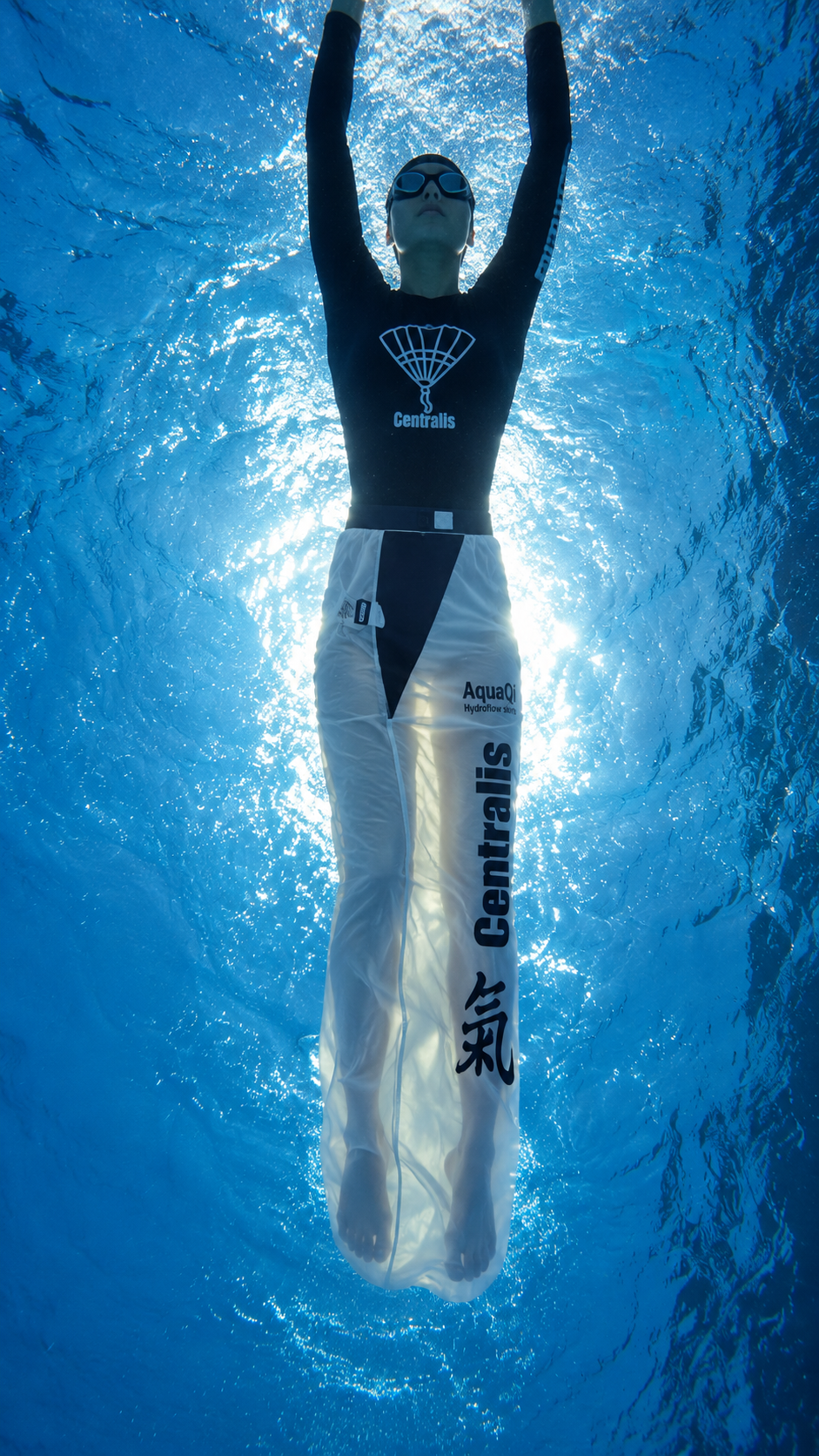
Underwater AquaQi swimmer photographed in a vertical composition demonstrating body position and movement
THE ALIGNMENT CONNECTION

A Long Body Line. A Connected Movement.

From the head and shoulders to the hips and legs, each part of the body influences the overall shape moving through water.

A strong swimming position does not depend on holding every muscle rigidly.

Instead, the swimmer organizes the body so that movement can travel through it without unnecessary interruption.

Alignment is something we maintain through movement, not just before it.

Why Alignment Can Be Difficult to Feel

On land, a mirror can help us recognize changes in posture.

Underwater, we usually cannot see our entire body while we are moving.

Instead, swimmers depend on a combination of sensation, instruction, video analysis and repetition.

A coach may clearly notice a change in hip position or kick timing that the swimmer finds difficult to recognize.

This gap between what movement looks like and what movement feels like is why physical feedback can become useful.

Sometimes the most useful information in swimming is not what we see, but what we learn to feel.

AquaQi Makes Lower-Body Movement More Noticeable

AquaQi surrounds both legs with a continuous enclosure of lightweight sport fabric.

The skirt begins around the hips, continues along the legs and extends several inches beyond the feet.

Rather than attaching a rigid blade to the feet, it introduces a changing fabric surface around the lower body.

As the swimmer moves, the fabric can open, narrow, fold and change its tension.

Those changes may make certain movements more noticeable to the wearer.

A different hip position, a change in kick amplitude or an interruption in the body wave can create a different sensation of water resistance.

AquaQi does not automatically identify the correct technique. Its value here is providing another physical reference that swimmers can explore.

BODY + FABRIC + WATER

Feel the Connection.

The body creates movement. The fabric responds to that movement. Water pressure changes the fabric in return.

This interaction introduces another form of sensory feedback during underwater movement practice.

Alignment in Motion

A body wave moves through several positions during each complete cycle.

At one moment, the hips may be rising while the lower legs follow.

At another, the swimmer may be extending into a longer line as the active movement settles.

The purpose is not to freeze the swimmer into one shape.

It is to understand how the body changes shape without losing the direction of travel.
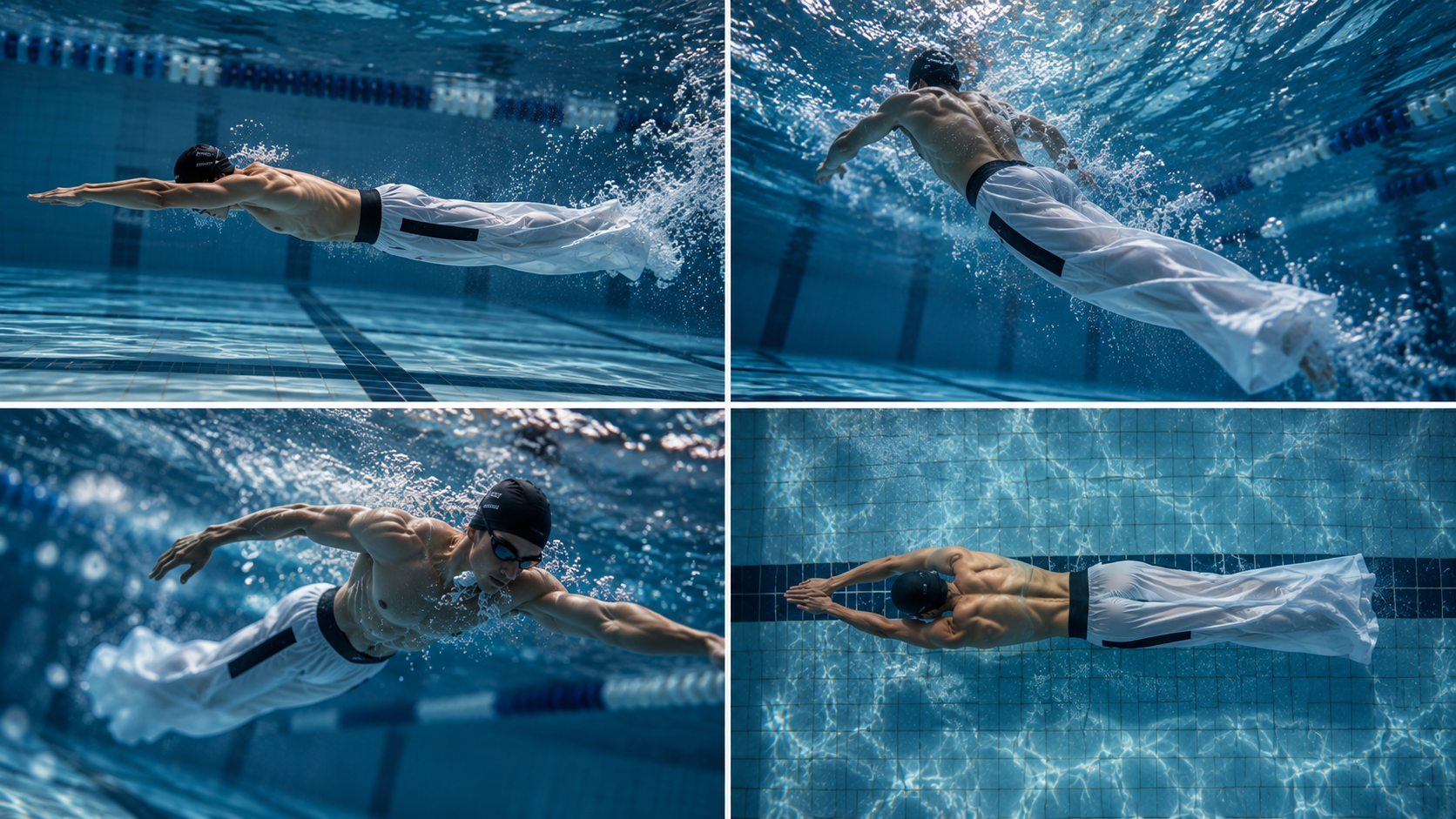
Athletic swimmer moving through an underwater pool with AquaQi fabric and visible water turbulence

Alignment and the Moment Between Kicks

Swimming propulsion gets much of the attention because it produces visible movement.

But what happens after a kick is also important.

As the swimmer continues traveling through water, the shape of the body affects how the glide is experienced.

A disconnected movement can interrupt the transition from propulsion to glide.

A coordinated movement can make that transition feel more continuous.

With AquaQi, the fabric continues responding as the active kick ends, allowing the swimmer to notice this change in resistance and motion.

INITIATE → TRANSMIT → PROPEL → RELEASE → GLIDE

Alignment in Freediving

Freedivers pay close attention to body position, movement rhythm and unnecessary resistance.

These relationships matter because underwater movement takes place within the diver's existing physical abilities and breath limits.

A connected body position can feel different from a movement involving unnecessary twisting, exaggerated kicks or poor coordination.

Experienced practitioners may explore AquaQi as an additional movement surface during properly supervised training.

AquaQi is not a flotation device, a substitute for diving equipment or a method for safely increasing breath-hold duration.

Underwater breath-hold training requires appropriate instruction, a trained buddy and established freediving safety procedures.

Learning Through Contrast

One useful way to explore body alignment is to compare different sensations.

During a suitable, supervised surface-swimming session, the swimmer may explore a small body wave and then a slightly larger one.

They may observe how the movement feels when it begins at the hips, compared with kicking primarily from the knees.

The idea is not to exaggerate incorrect techniques or force uncomfortable positions.

Instead, it is to develop awareness of how small changes influence movement, resistance and rhythm.

With AquaQi, the changing fabric tension may add another sensation to those comparisons.

THE ALIGNMENT CONNECTION

Stay Connected.
Move With Purpose.

Alignment is not one perfect pose.

It is the changing relationship between the head, torso, hips and legs as the body moves through water.

With AquaQi, the surrounding fabric adds another way to experience that connection.

Better Alignment Begins With Awareness

Effective underwater movement is a continuous exchange between shape, direction and resistance.

The swimmer is never completely separate from the water.

Every change in body position alters how the body interacts with it.

A connected wave, a controlled transition and an organized glide can each become part of learning to move with greater awareness.

AquaQi introduces a fabric surface that responds to those movements, offering a different sensory experience around the legs.

The purpose is not to claim a single perfect swimming position or guaranteed performance.

It is to become more attentive to the relationship between body, fabric and water.

Connection before force. Awareness before speed. Movement with purpose.


CENTRALIS / AQUAQI HYDROFLOW

Explore Body-Driven Swimming.

Discover the AquaQi HydroFlow Skirt and explore how responsive fabric introduces a new relationship between body-wave movement, resistance and rhythm.

AquaQi Body Alignment Body Wave Swimming Technique HydroFlow Skirt Underwater Movement
← BACK TO JOURNAL

Why Body Alignment Matters Underwater

Underwater, small changes in the body can create surprisingly different sensations. A dropped hip, a disconnected kick, or a break in the body’s line changes how water moves around the swimmer.

Alignment is not simply about looking streamlined. It is about allowing the body to move through water as one connected system — with the torso, hips, legs, and direction of travel working together.


Water Responds to the Shape You Give It

Every swimmer creates a shape in the water.

When that shape is long and coordinated, water can move around it more cleanly. When different parts of the body move out of line, the swimmer presents a changing surface to the water.

That does not mean the body should become rigid. Good underwater movement still requires flexibility, especially when performing a body wave or dolphin-style motion.

The goal is connection rather than stiffness.

Alignment is dynamic

A swimmer can be moving, bending and creating a wave while still maintaining a clear relationship between the head, torso, hips and legs. Alignment is not one frozen position — it changes continuously with the movement.

The Hips Are Part of the Conversation

It is easy to think about underwater propulsion mainly in terms of the feet or legs.

But powerful aquatic movement often begins much higher.

The torso and hips initiate movement, and that energy travels downward through the body. When this sequence is coordinated, the legs become the continuation of the wave rather than an isolated engine at the end of the body.

This relationship is especially noticeable during dolphin-style motion.

If the upper body, hips and legs lose their connection, the wave can become fragmented. The swimmer may still be moving strongly, but some of that effort can be directed into movement that does not contribute effectively to the desired direction.

The goal is not simply to move more.
It is to send movement through the body with purpose.

That idea also sits at the center of AquaQi HydroFlow swim training, where rhythm, body position and core-driven motion become part of the same practice.

Streamline Is More Than a Pose

Swimmers often learn streamline as a position: arms extended, body long, legs together.

Underwater movement adds another challenge.

The swimmer must preserve the advantages of that long body shape while also creating propulsion.

This is where alignment becomes dynamic. The body needs to move without allowing the movement itself to collapse the overall line.

For freedivers, this relationship can be especially important because unnecessary movement can demand effort that the diver would rather conserve.

A relaxed, coordinated movement pattern can therefore feel very different from an aggressive movement pattern, even when both are intended to create propulsion.

Think direction, not perfection

Alignment does not mean forcing the body into a perfectly straight shape at every moment. It means becoming aware of where the body is directing movement and whether each part is supporting that direction.

Why Alignment Can Be Difficult to Feel

One challenge of swimming is that it can be difficult to see your own body.

On land, a mirror can immediately show posture. In the water, a swimmer often relies on sensation, coaching, video, or repeated practice to understand what the body is actually doing.

The difference between a well-connected movement and a disconnected one may be visually obvious to a coach but surprisingly difficult for the swimmer to recognize from inside the movement.

That is why sensory feedback can be useful.

Sometimes the most useful information in swimming is not what the swimmer sees, but what the swimmer learns to feel.

AquaQi Makes the Lower Body More Noticeable

AquaQi surrounds both legs with one continuous surface of lightweight fabric.

Instead of each leg interacting with the water independently, the HydroFlow Skirt creates a larger responsive surface around the lower body.

As the swimmer moves, the fabric changes shape.

It can stretch, fold, narrow, open and press against the legs depending on the movement and the direction of the surrounding water.

Those changes create sensations that may help the swimmer notice what is happening through the hips and legs.

When the body wave travels smoothly, the fabric responds to that sequence. When the lower body moves differently, the sensation of the material can change as well.

Body + Fabric + Water

The body creates the movement. The fabric responds to it. The water shapes the fabric in return. AquaQi places the swimmer inside this continuous feedback loop.

This is one reason the concept of the Fabric Monofin is different from simply replacing one type of fin with another. The changing shape of the material is part of the experience.


Alignment in Freediving

Freediving places particular attention on efficient movement underwater.

The swimmer is working with a limited breath, so rhythm, relaxation and unnecessary resistance become especially noticeable parts of the experience.

AquaQi can be used as a training environment for exploring those sensations.

The fabric does not tell the diver that one position is automatically correct. Instead, it changes the physical feedback surrounding the legs, giving the swimmer another way to compare different movement patterns.

A diver might experiment with a smaller body wave, a different hip position, a longer line, or a softer kick and notice how the fabric and water respond.

That turns practice into exploration.

Centralis looks at this relationship more specifically in freediving training with AquaQi HydroFlow.

Alignment and the Moment Between Kicks

Propulsion gets attention because it creates visible movement.

But the moments between propulsion are equally interesting.

After a kick or body wave, the swimmer continues moving through the water. The shape of the body during this phase influences how that momentum feels.

A swimmer who immediately introduces unnecessary movement may interrupt the sensation of glide. A swimmer who remains connected can experience the transition from propulsion into movement more clearly.

This relationship between action and release is part of what gives skilled underwater movement its fluid quality.

The kick is not an isolated event.

It belongs to a larger rhythm: initiate, transmit, propel, release, glide.

Learning Through Contrast

One of the most useful ways to understand movement is to experience contrast.

Try a movement one way, then change it slightly.

Move from the knees, then explore initiating higher from the hips. Create a large body wave, then reduce its amplitude. Tense the body, then repeat the movement with less unnecessary tension.

The purpose is not to declare one sensation universally correct.

It is to give the swimmer enough information to recognize differences.

AquaQi can amplify that exploration because the fabric itself changes as the movement changes.

Better alignment begins with awareness:
feeling how one movement travels through the whole body and into the water.

Underwater movement is a continuous exchange between shape, motion and resistance. AquaQi gives swimmers another way to explore that exchange — not by prescribing a single perfect position, but by making the relationship between body, fabric and water easier to experience.