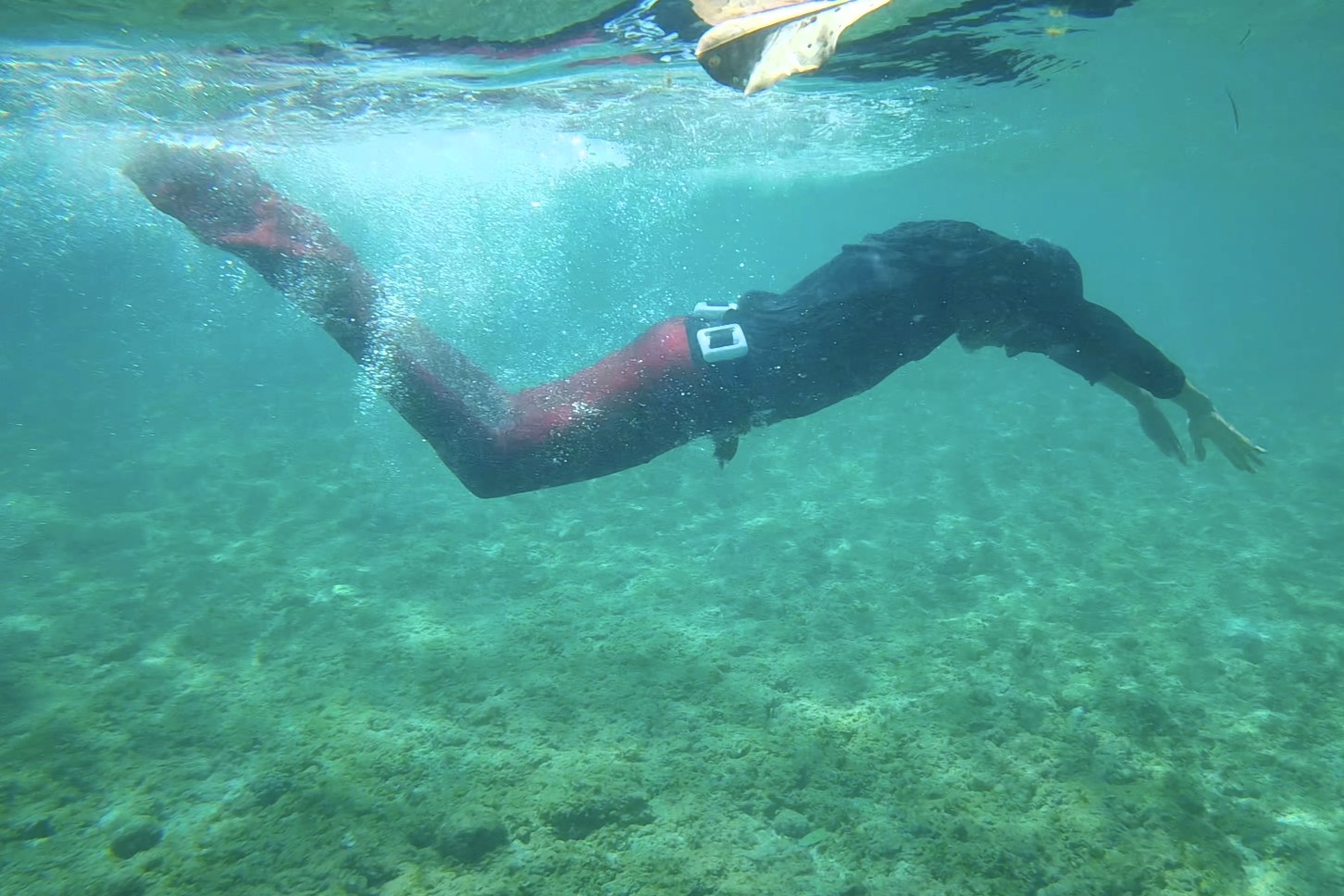
Why Body Alignment Matters Underwater
Underwater, small changes in the body can create surprisingly different sensations. A dropped hip, a disconnected kick, or a break in the body’s line changes how water moves around the swimmer.
Alignment is not simply about looking streamlined. It is about allowing the body to move through water as one connected system — with the torso, hips, legs, and direction of travel working together.
Water Responds to the Shape You Give It
Every swimmer creates a shape in the water.
When that shape is long and coordinated, water can move around it more cleanly. When different parts of the body move out of line, the swimmer presents a changing surface to the water.
That does not mean the body should become rigid. Good underwater movement still requires flexibility, especially when performing a body wave or dolphin-style motion.
The goal is connection rather than stiffness.
A swimmer can be moving, bending and creating a wave while still maintaining a clear relationship between the head, torso, hips and legs. Alignment is not one frozen position — it changes continuously with the movement.
The Hips Are Part of the Conversation
It is easy to think about underwater propulsion mainly in terms of the feet or legs.
But powerful aquatic movement often begins much higher.
The torso and hips initiate movement, and that energy travels downward through the body. When this sequence is coordinated, the legs become the continuation of the wave rather than an isolated engine at the end of the body.
This relationship is especially noticeable during dolphin-style motion.
If the upper body, hips and legs lose their connection, the wave can become fragmented. The swimmer may still be moving strongly, but some of that effort can be directed into movement that does not contribute effectively to the desired direction.
The goal is not simply to move more.
It is to send movement through the body with purpose.
That idea also sits at the center of AquaQi HydroFlow swim training, where rhythm, body position and core-driven motion become part of the same practice.
Streamline Is More Than a Pose
Swimmers often learn streamline as a position: arms extended, body long, legs together.
Underwater movement adds another challenge.
The swimmer must preserve the advantages of that long body shape while also creating propulsion.
This is where alignment becomes dynamic. The body needs to move without allowing the movement itself to collapse the overall line.
For freedivers, this relationship can be especially important because unnecessary movement can demand effort that the diver would rather conserve.
A relaxed, coordinated movement pattern can therefore feel very different from an aggressive movement pattern, even when both are intended to create propulsion.
Alignment does not mean forcing the body into a perfectly straight shape at every moment. It means becoming aware of where the body is directing movement and whether each part is supporting that direction.
Why Alignment Can Be Difficult to Feel
One challenge of swimming is that it can be difficult to see your own body.
On land, a mirror can immediately show posture. In the water, a swimmer often relies on sensation, coaching, video, or repeated practice to understand what the body is actually doing.
The difference between a well-connected movement and a disconnected one may be visually obvious to a coach but surprisingly difficult for the swimmer to recognize from inside the movement.
That is why sensory feedback can be useful.
Sometimes the most useful information in swimming is not what the swimmer sees, but what the swimmer learns to feel.
AquaQi Makes the Lower Body More Noticeable
AquaQi surrounds both legs with one continuous surface of lightweight fabric.
Instead of each leg interacting with the water independently, the HydroFlow Skirt creates a larger responsive surface around the lower body.
As the swimmer moves, the fabric changes shape.
It can stretch, fold, narrow, open and press against the legs depending on the movement and the direction of the surrounding water.
Those changes create sensations that may help the swimmer notice what is happening through the hips and legs.
When the body wave travels smoothly, the fabric responds to that sequence. When the lower body moves differently, the sensation of the material can change as well.
The body creates the movement. The fabric responds to it. The water shapes the fabric in return. AquaQi places the swimmer inside this continuous feedback loop.
This is one reason the concept of the Fabric Monofin is different from simply replacing one type of fin with another. The changing shape of the material is part of the experience.
Alignment in Freediving
Freediving places particular attention on efficient movement underwater.
The swimmer is working with a limited breath, so rhythm, relaxation and unnecessary resistance become especially noticeable parts of the experience.
AquaQi can be used as a training environment for exploring those sensations.
The fabric does not tell the diver that one position is automatically correct. Instead, it changes the physical feedback surrounding the legs, giving the swimmer another way to compare different movement patterns.
A diver might experiment with a smaller body wave, a different hip position, a longer line, or a softer kick and notice how the fabric and water respond.
That turns practice into exploration.
Centralis looks at this relationship more specifically in freediving training with AquaQi HydroFlow.
Alignment and the Moment Between Kicks
Propulsion gets attention because it creates visible movement.
But the moments between propulsion are equally interesting.
After a kick or body wave, the swimmer continues moving through the water. The shape of the body during this phase influences how that momentum feels.
A swimmer who immediately introduces unnecessary movement may interrupt the sensation of glide. A swimmer who remains connected can experience the transition from propulsion into movement more clearly.
This relationship between action and release is part of what gives skilled underwater movement its fluid quality.
The kick is not an isolated event.
It belongs to a larger rhythm:
initiate, transmit, propel, release, glide.
Learning Through Contrast
One of the most useful ways to understand movement is to experience contrast.
Try a movement one way, then change it slightly.
Move from the knees, then explore initiating higher from the hips. Create a large body wave, then reduce its amplitude. Tense the body, then repeat the movement with less unnecessary tension.
The purpose is not to declare one sensation universally correct.
It is to give the swimmer enough information to recognize differences.
AquaQi can amplify that exploration because the fabric itself changes as the movement changes.
Better alignment begins with awareness:
feeling how one movement travels through the whole body and into the water.
Underwater movement is a continuous exchange between shape, motion and resistance. AquaQi gives swimmers another way to explore that exchange — not by prescribing a single perfect position, but by making the relationship between body, fabric and water easier to experience.