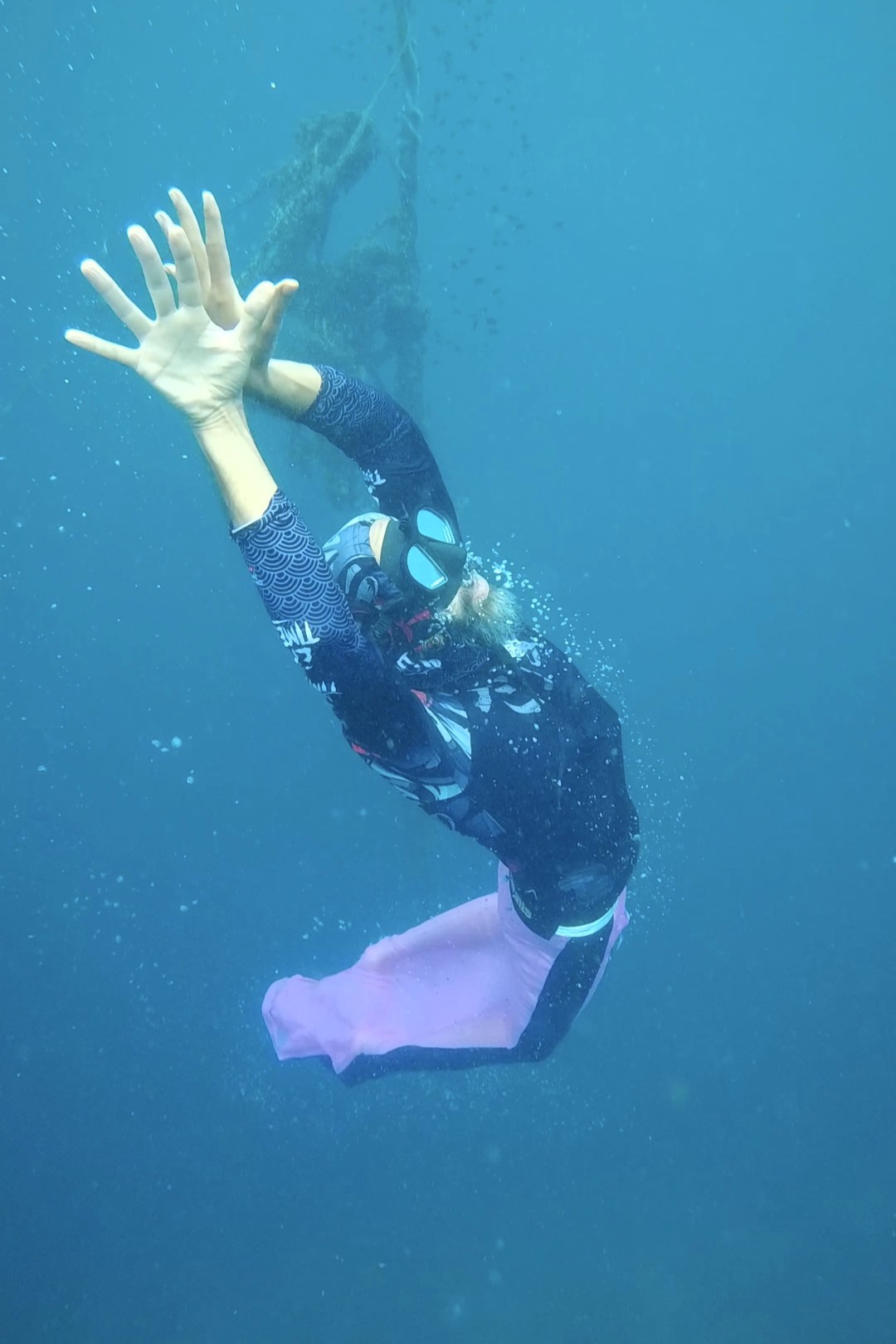
Beyond the Tail: Training Movement for Mermaiding & Aquatic Performance
A beautiful mermaid performance may look effortless, but beneath the visual effect is something very physical: body control, rhythm, alignment, breath awareness and the ability to move through water as one continuous form.
The tail may complete the image. The movement, however, begins with the performer.
The Performance Starts Before the Costume
Mermaiding brings together swimming, performance and visual expression.
A performer may be thinking about the line of the arms, the position of the head, the direction of the eyes and the shape created for an audience or camera.
At the same time, the body still has to move effectively underwater.
That means the visual performance and the swimming technique cannot be completely separated.
A beautiful pose can lose its effect if the movement leading into it feels abrupt. A strong body wave may create propulsion, but for performance it also needs to connect naturally into turns, gestures and moments of stillness.
Flow begins with the performer’s ability to organize the body, create rhythm and move with intention. Equipment can extend that movement, but the underlying skill is developed in the body.
Training the Body Wave
The body wave is one of the most recognizable elements of mermaid-style swimming.
But a fluid wave is not simply a large movement of the knees.
It can begin through the chest, torso and hips before traveling downward through the legs. The sections of the body participate in sequence, creating the impression that a wave is passing through the swimmer rather than the swimmer simply kicking.
For aquatic performance, this matters because the quality of that wave influences almost everything around it.
It can affect acceleration, the visual line of the body, the transition into a glide and the feeling of continuity between one movement and the next.
A performer does not only travel through the water.
The performer shapes how that movement is seen.
AquaQi provides a different environment for exploring this type of movement. Both legs are surrounded by a single flexible surface, creating the connected sensation associated with a fabric monofin while allowing the material itself to respond continuously to the swimmer.
Movement Without Hiding Behind the Tail
A full mermaid tail creates a powerful visual transformation.
That is precisely why training without one can sometimes be useful.
When the costume is removed, attention can move back toward the body itself.
Where does the wave begin?
Are the hips driving the movement?
Does the upper body remain calm while the lower body works?
Can the swimmer transition from propulsion into a clean glide?
These questions become easier to explore when the performer is not concentrating on the appearance, weight or structure of a full performance tail.
AquaQi can be used as a bridge between ordinary swimming and full-tail performance — allowing the performer to explore connected-leg movement while keeping the focus on rhythm, body awareness and technique.
This complements the ideas explored in AquaQi HydroFlow Skirt: Elevate Your Mermaiding Skills, where AquaQi is introduced specifically as a training option for mermaid swimmers.
Flow Is More Than Forward Motion
Swimming training often focuses on moving from one end of the pool to the other.
Aquatic performance asks for more.
A performer may travel sideways, rotate, descend, rise, pause, arch, spiral or change direction while still trying to preserve a sense of ease.
This makes flow especially important.
Flow is not simply speed. It is the continuity between movements.
The most memorable underwater movement often happens when one action seems to become the next without a visible break.
The HydroFlow fabric can make those transitions interesting to explore because the material does not maintain one fixed shape.
As the performer turns or changes direction, the fabric follows with a slight delay, folds around the body and then opens again with the surrounding water.
That response can become part of the movement experience itself.
The Fabric Adds Its Own Motion
In performance, fabric can create movement beyond the body.
A hand stops, but fabric continues to travel.
The body turns, while the material follows through the water.
The swimmer changes direction, and folds that were compressed begin to open again.
AquaQi takes advantage of this natural delay.
Because the material extends beyond the feet, the visual movement can continue beyond the physical line of the swimmer’s body. At the same time, the performer can feel the way that material is responding to changes in direction and water pressure.
The performer creates the movement, the fabric extends it, and the water reshapes it. Each influences the others, creating a constantly changing visual and physical relationship.
Practicing Transitions
Individual poses can be practiced almost anywhere.
Transitions are harder.
A performer must move from propulsion into a pose, from a pose into a turn, from a descent into an ascent, or from a strong body wave into apparent stillness.
Those transitions are where movement quality becomes visible.
AquaQi gives performers another way to explore them because the fabric reacts differently during acceleration, deceleration and changes of direction.
Instead of simply asking, “Did I reach the pose?” the performer can pay attention to the entire journey into and out of it.
That can shift training away from isolated shapes and toward complete movement sequences.
Performance and Athletic Movement Belong Together
Mermaiding is visually expressive, but that does not make it separate from athletic movement.
Body control, core engagement, coordination and underwater awareness all contribute to what an audience ultimately sees.
The strongest visual impression may come from something technically subtle: a relaxed upper body, a cleaner line through the hips, a quieter transition or a body wave that travels smoothly rather than appearing forced.
This is also where mermaiding connects with broader AquaQi training.
The same ideas of connected movement, body awareness and fluid propulsion explored in AquaQi: The Future of Monofins and Fluid Motion can become tools for artistic expression when placed in a performance context.
Finding Your Own Underwater Signature
Not every performer should move in exactly the same way.
Some movements are expansive and dramatic. Others are controlled and minimal. One performer may emphasize powerful body waves, while another may build a style around long glides, turns and moments of suspension.
Training should make more of those choices available rather than forcing every swimmer into one visual language.
A responsive training tool can help because it invites experimentation.
Change the size of the wave.
Change its tempo.
Initiate from a different part of the torso.
Move quickly and then release into stillness.
Notice what happens to the body, the fabric and the water each time.
The goal is not simply to look like a mermaid.
It is to develop a way of moving underwater that feels unmistakably your own.
AquaQi offers mermaid swimmers and aquatic performers a space between conventional swim training and full-tail performance — a place to explore body wave, alignment, rhythm and expression while allowing fabric and water to become active parts of the movement.